Look for the clock before looking at the balance
A founder presents a treasury address with a large token balance and calls it a two-year lock. For a researcher, the first useful question is when those two years begin. Some contracts calculate a schedule from the start recorded at deployment. Others can track separate deposits or impose different conditions for each grant. OpenZeppelin documents a VestingWallet implementation in which assets received during the schedule follow the existing clock. A token that arrives long after the start can therefore already be partly available for release. This is a property of the implementation under examination. The same arithmetic cannot be assumed for every contract described as a vesting wallet.
Reconstruct a deliberately simple allocation
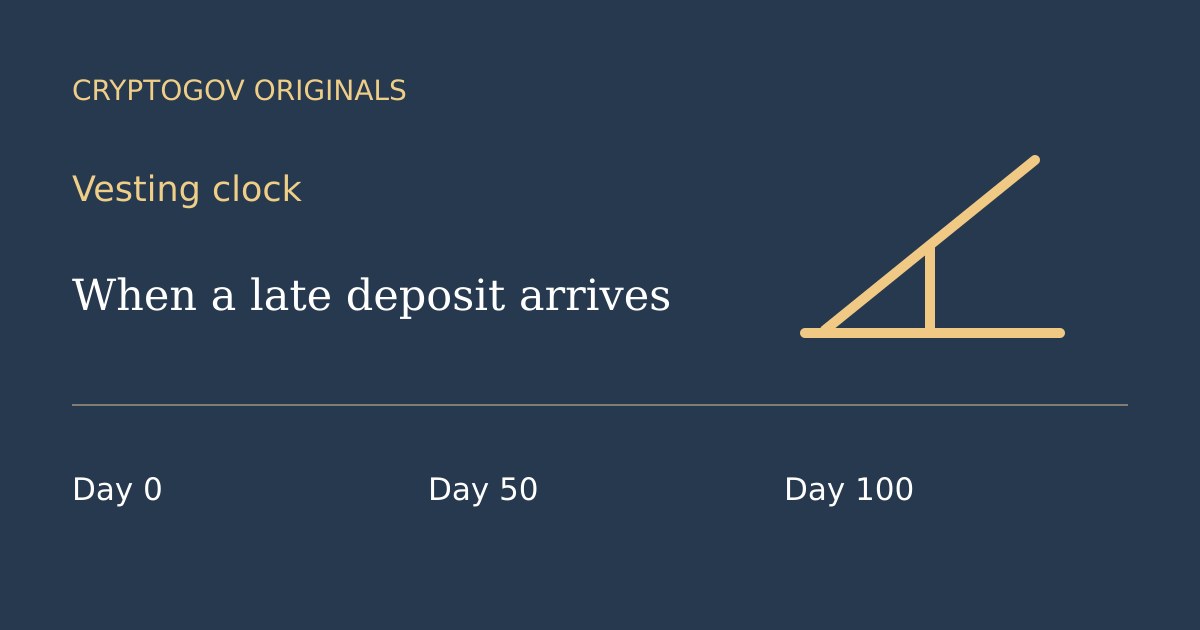
Consider a hypothetical linear schedule lasting exactly one hundred days. The wallet starts empty and receives ten thousand units halfway through the schedule. Assume a standard token, no earlier releases, no cliff, and a transfer at the exact midpoint. Under the described model approximately five thousand units have vested immediately after deposit. A spreadsheet that instead starts a fresh hundred-day clock for those units would show zero available at that moment. The difference arises without anyone changing the contract. The two calculations use different starting assumptions. To check a real example, record the timestamp and units, read the schedule and compare the result with the contract’s releasable amount at the same block.
Identify the beneficiary separately
The wallet address that holds the tokens is one part of the investigation. Another is the account entitled to receive a release. In an ownable vesting implementation, examine ownership and its transfer rules as well as token movements. A claim that tokens remain in one wallet says very little about whether the economic beneficiary can change. Record which statements can be derived from verified code and which depend on a project identifying a person or a company behind an address. For a useful public file, publish the calculation inputs alongside the conclusion. Someone arriving a month later should be able to reproduce the old result and explain why the current figure differs.
One final control is to compare assets deposited with assets already released. A schedule calculated solely from the remaining wallet balance can understate the original allocation after earlier withdrawals. Preserve both readings and the timestamp used for the calculation.
Go deeper on CryptoGov
Sources & verification
Researched and published by CryptoGov Editorial Desk. Source publication and effective dates are explained in the article where relevant.