What is current and what is established
The Financial Stability Board’s crypto-assets page lists a note to the G20 dated 12 October 2026 on global stablecoin arrangements, cross-border vulnerabilities and monitoring. This article examines that policy focus on 31 October. It does not present the note as a new domestic law or imply that an international recommendation automatically changes a customer contract.
The FSB’s overview also points to its 2025 implementation review and continuing gaps between jurisdictions. A BIS-hosted summary of that review discusses issues including redemption, reserve eligibility, liquidity management and cross-border coordination. These are related policy materials with different publication histories, not one regulatory event.
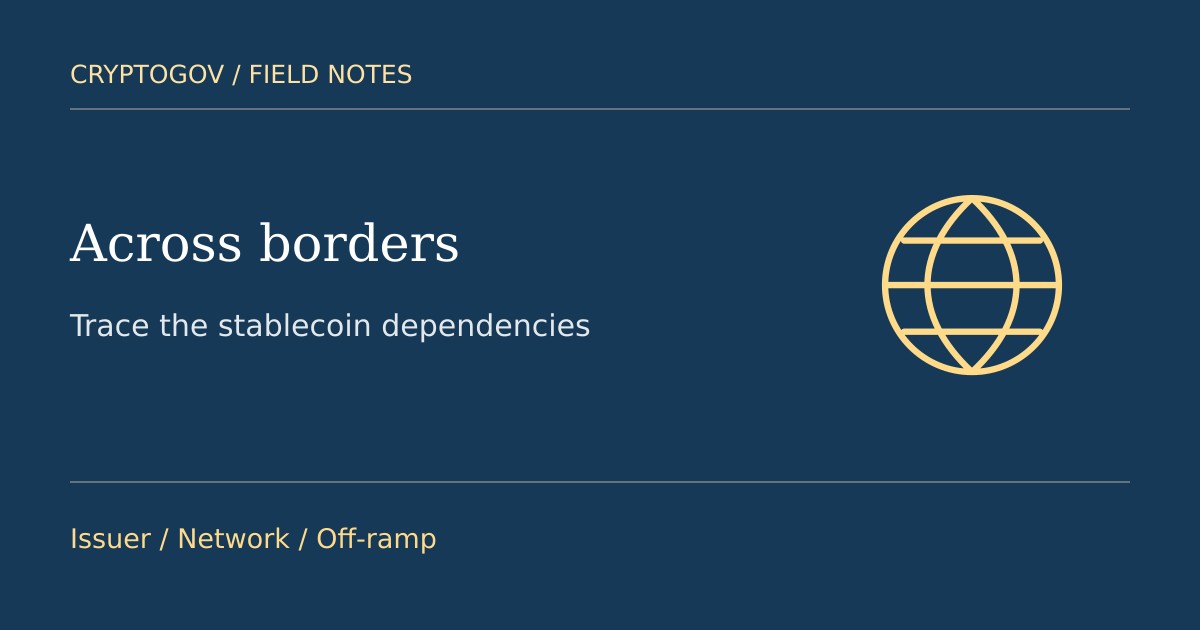
Map a payment as a chain
For a business considering stablecoin settlement, CryptoGov proposes drawing the transaction as a sequence of dependencies. A sender obtains the asset, transfers it, and expects the recipient to use or convert it. The important business question is where that expectation depends on a separate institution, agreement or operating process.
Imagine a hypothetical supplier who accepts a token on Friday but needs local-currency funds for a payment on Monday. The relevant comparison includes the supplier’s actual conversion route and contractual access, not simply the speed of the blockchain transfer. No particular delay or loss is assumed in this example. It illustrates why completing one technical step may not finish a commercial obligation.
Define completion before sending
A useful treasury policy distinguishes delivery of the token from completion of the underlying invoice obligation. The parties can ask what they regard as successful performance, what evidence they retain and who handles an exception. These are proposed business-control questions; their answers depend on the transaction and applicable legal arrangements.
The same discipline helps prevent a misleading comparison between a stablecoin and a bank balance. A familiar reference currency does not establish that every holder has identical rights, access or remedies. The precise arrangement needs examination on its own terms, particularly when several jurisdictions and intermediaries are involved.
The practical conclusion is to evaluate the whole route. Cross-border monitoring matters because an asset can move across systems whose responsibilities do not move together. For managers, the most useful output is a clear dependency map and an exception plan, not a claim that a fast settlement demonstration proves universal reliability. That approach preserves the possible operational benefits while making the unresolved commercial questions visible.
Go deeper on CryptoGov
Sources & verification
Researched and published by CryptoGov Editorial Desk. This article contains editorial analysis; assessments are distinguished from reported facts.