Read the two ceilings separately
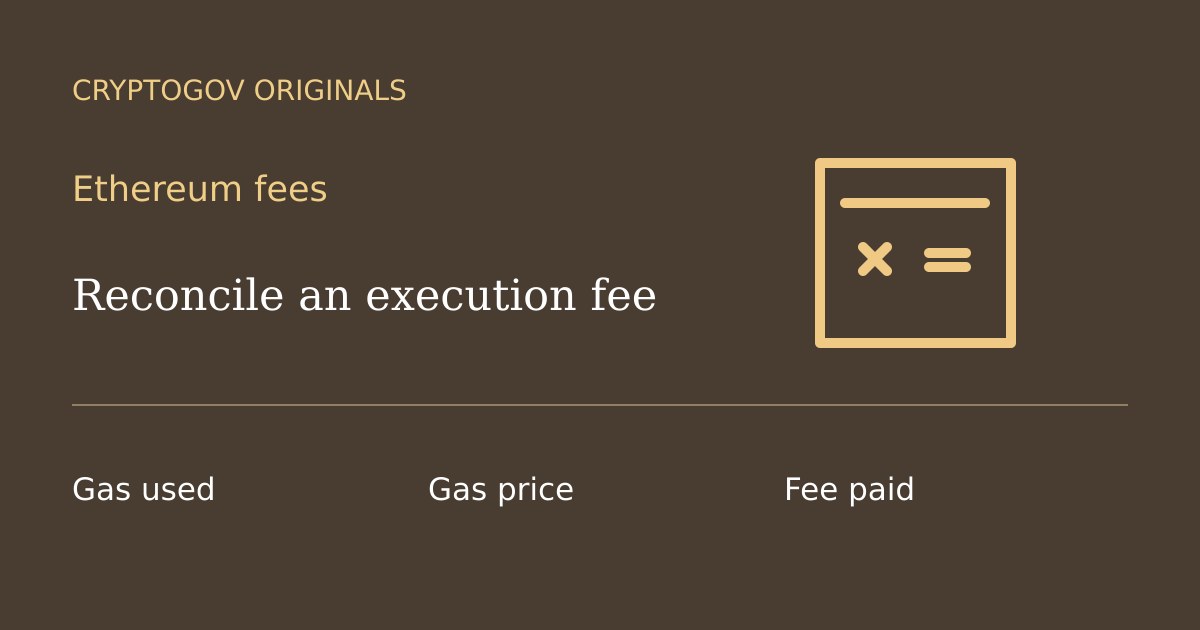
A payment screen may show a maximum possible execution fee alongside a smaller estimate. A user who records the larger number as the amount paid can make an otherwise correct set of accounts look inconsistent. On Ethereum, the gas limit caps the amount of execution gas an instruction can use. A maximum fee per gas sets a price ceiling on each unit. Multiplying those two ceilings gives a bound for the execution component under the transaction settings. To establish the actual charge after inclusion, use the receipt. Look for gas used and the effective gas price. Distinguish these fields from the amount of ETH transferred to the recipient.
Reconcile a fictional transfer by hand
Assume a transfer consumes 21,000 units of gas at an effective price of twelve gwei per unit. The execution charge is 252,000 gwei, equivalent to 0.000252 ETH. If the sender transferred 0.1 ETH and no other balance changes occurred, the sender’s balance would fall by 0.100252 ETH. The recipient would receive 0.1 ETH. Now suppose the wallet showed a maximum fee per gas of thirty gwei and a gas limit of 21,000. Its ceiling would have been 0.000630 ETH. The difference of 0.000378 ETH between the bound and the actual charge is not a second payment owed by the recipient. These illustrative prices are chosen to make the arithmetic reproducible.
Check the receipt before explaining a discrepancy
Record the transaction hash, network, status, transferred value, gas used, effective gas price and the units shown by the explorer. A receipt with a failed execution deserves its own line in the ledger because work can consume gas even when the intended transfer or contract state change does not complete. This example covers an ordinary Ethereum execution fee. Different transaction types and other networks may expose additional fee components, so identify those before applying the same worksheet elsewhere. For practice, repeat the arithmetic using two completed transactions from an explorer. Convert the fee to ETH first, and only then convert to a reporting currency using a stated exchange rate and time.
One last unit check catches an expensive spreadsheet error: a gwei is one billionth of an ETH. Leaving a gas price in gwei while labelling the product ETH exaggerates the fee by a factor of one billion.
Go deeper on CryptoGov
Sources & verification
Researched and published by CryptoGov Editorial Desk. Source publication and effective dates are explained in the article where relevant.